
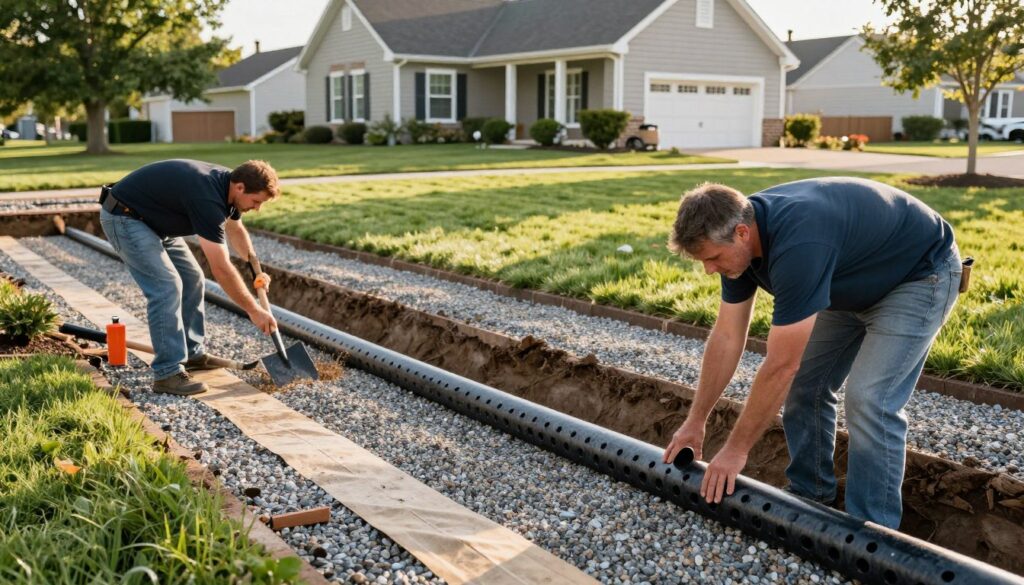
Yes, French drains can work in clay soil, but only if they’re installed correctly. Standard installs often fail in clay-heavy yards because the design doesn’t account for how slowly clay drains. Here in the Northwest Chicago suburbs, where clay soil is essentially the default, we see this problem constantly.
The short answer: A French drain in clay soil needs a proper outlet, the right gravel, and a filter fabric that won’t clog. Skip any one of those and you’ve got a soggy yard again by spring.
Why Clay Soil Makes Drainage Harder
Clay particles are tiny and pack tightly together, which means water moves through them at a crawl. Sandy soil can absorb an inch of rain in minutes. Clay soil? It can take hours, and in heavy storms it barely absorbs at all.
A French drain works by intercepting groundwater and redirecting it to a safe outlet, like a street, dry well, or low point on your property. The problem in clay yards is that water saturates the gravel trench faster than the surrounding soil can absorb it. If there’s no clear outlet, the trench just becomes a buried pond.
The fix isn’t skipping the French drain. It’s designing it for clay conditions from the start.
What a Proper Clay-Soil French Drain Needs
When we install French drains in Mount Prospect and the surrounding suburbs, we build them with clay soil in mind from day one. Here’s what that looks like:
A defined outlet. The drain has to go somewhere. We route it to a storm sewer, a curb, or a dry well. No outlet means no drainage.
Clean washed gravel (not pea gravel). Larger angular stone creates air pockets that water can actually move through. Pea gravel compacts and clogs over time.
Non-woven filter fabric. This wraps the gravel and pipe to keep clay particles from migrating in and silting up the system. It’s one of the most skipped steps in DIY installs.
Adequate slope. The pipe needs at least a 1% grade (1 inch of drop per 10 feet) to keep water moving. Flat or back-pitched installs hold water instead of draining it.
Miss any of these and you’ll be digging it up in a few years.
Still Getting Standing Water After Rain?
If your yard pools after every storm or your basement wall is always damp, the drainage issue won’t fix itself. Clay soil only gets more compacted over time.
We assess drainage problems across Mount Prospect, Arlington Heights, Buffalo Grove, and the surrounding suburbs. A quick site visit usually tells us everything we need to know about where the water is coming from and where it needs to go.
Contact A&N Outdoors to schedule a drainage assessment and we’ll walk you through exactly what your yard needs.


