
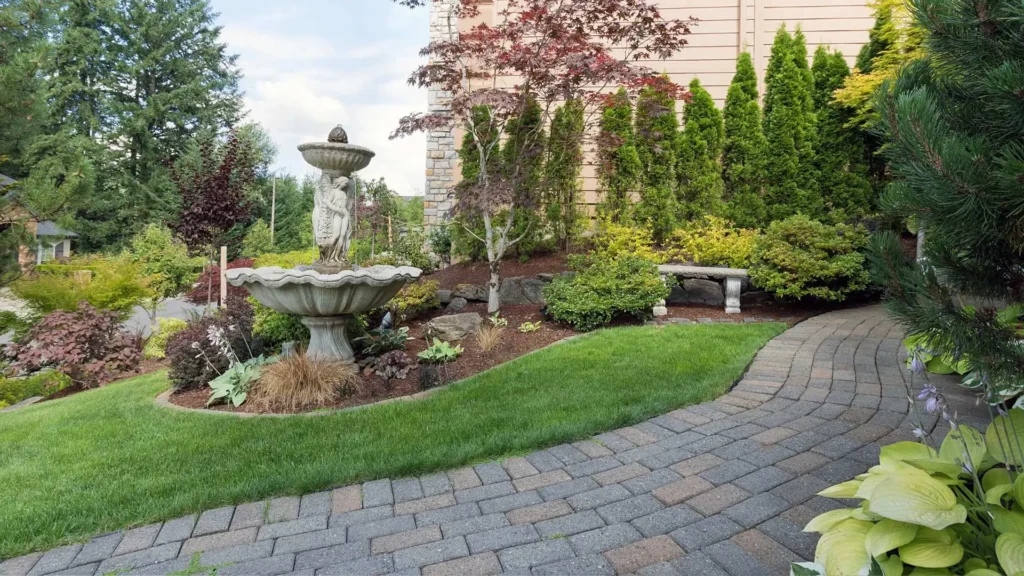
The lowest-cost hardscape features for an Arlington Heights yard are the ones that use the least material and the least labor: a gravel or paver walkway instead of a driveway-width path, a small patio kept under 120 square feet, a low segmental block wall instead of a tall structural one, and a simple built-in fire pit instead of a full outdoor kitchen. Below are current price ranges for each, what actually drives the cost up or down, and the Arlington Heights permit rules that affect how big you can go before the project needs a plan review.
Gravel or paver walkways
A walkway is the cheapest linear-foot hardscape you can add, because it doesn’t need the same depth of excavation or compacted base a patio does — there’s no furniture or dining table loading the surface.
Concrete pavers run about $15 to $25 per square foot installed, brick pavers $15 to $30, and natural stone options like limestone or bluestone $20 to $40. A path in loose gravel or crushed stone costs less than any of those — the material itself is closer to $1 to $3 per square foot — but a version that actually holds its edges over a Chicago winter needs steel or paver edging and a landscape fabric base underneath it, which adds to that number.
A narrow 3-foot-wide path from the driveway to a side gate or a garden gate is a common way to get the visual upgrade of a walkway for a few hundred dollars in material.
A patio sized under the permit line
Arlington Heights treats a patio as flatwork, in the same permit category as driveways and stoops. An outside permit-lookup resource puts the exemption at 120 square feet for an at-grade slab — no more than 30 inches above the surrounding grade and not part of an accessible route — meaning a patio under that size skips the permit review and inspection fees entirely.
A 10-by-12 patio (120 square feet) fits a small dining set and stays inside that line. In concrete pavers, that’s roughly $1,800 to $3,000 installed at $15–$25 per square foot; the same footprint in natural stone runs closer to $2,400–$4,800. Keeping the shape simple — a rectangle instead of a curve or a herringbone pattern — also holds the labor cost down, since intricate cutting and fitting is what pushes patio pricing toward the $55 per square foot end of the Chicagoland range rather than the $25 end.
A patio doesn’t have to be finished all at once, either. A base and border built to its final size now, filled with pavers in the center this year and the remaining field completed next season, spreads the cost across two budgets without redoing any of the site work.
A low wall instead of a tall one
Arlington Heights draws a hard line at 3 feet for retaining walls: a landscaping wall at 3 feet or under uses one permit category, and anything taller needs the structural wall permit, which brings engineering review into the project. Staying under that line keeps a sloped or uneven yard project in the simpler, cheaper permit path — and it’s also the size where segmental block, the least labor-intensive material to install, does its best work.
In the Chicago market, timber walls price around $10 to $20 per square foot, segmental interlocking block in a similar $15 to $35 range, poured concrete $20 to $35, and natural stone $15 to $70 depending on the stone. For a wall under 3 feet, timber is the cheapest option up front but needs more maintenance over its life; segmental block costs a bit more but holds up through Chicago’s freeze-thaw cycles with less upkeep, which is why it’s the material most homeowners land on for a short retaining or garden wall.
A segmental block wall wide enough on top to sit on also does double duty as a seat wall around a patio or fire pit — one structure covering both the grading problem and the seating, instead of paying for a retaining wall and outdoor furniture separately.
A built-in fire pit instead of a full outdoor kitchen
A fire pit is one of the highest-value, lowest-cost additions to a yard, because the footprint is small and the labor is a fraction of what a kitchen or a full patio takes.
A basic wood-burning fire pit built from concrete block with a gravel base runs about $150 to $500 installed for a 24-inch pit. A more finished paver or block fire pit — matched to a patio’s material, in the 9-to-16-square-foot range most yards use — runs $325 to $2,000 depending on the block or stone chosen and whether it’s gas or wood-burning. Wood-burning stays the cheapest fuel option to install since it skips the gas line; natural gas fire pits, which need a permanent line run to the yard, climb into the $3,500-plus range.
Arlington Heights issues a specific permit for standalone permanent fire pits, separate from the flatwork permit — if the fire pit is being poured or built alongside new patio flatwork, that gets folded into the flatwork permit instead of filed twice. The Village also regulates open recreational fires by size (fuel area over roughly 3 feet across or 2 feet tall crosses into “bonfire” rules), restricts them to rear yards, and requires seasoned firewood only — worth checking against the current code before finalizing a design, since these thresholds get revised.
Permeable pavers for the drainage-prone spots
A section of yard that holds water after rain is usually the spot a homeowner is tempted to skip entirely rather than pay for drainage work on top of a patio or walkway. Permeable interlocking pavers solve part of that problem inside the hardscape budget rather than as a separate line item: water passes through the joints and the compacted stone base below instead of running off, which reduces (though doesn’t replace) the need for a French drain elsewhere in the yard.
Permeable pavers sit in the mid-to-upper part of the Chicagoland patio price range rather than the cheapest tier, so this option is less about the lowest sticker price and more about avoiding a follow-up drainage project later. For a low spot near a downspout or a side yard that stays soft into June, it’s often the cheaper path when weighed against a standard paver patio plus a separate drainage fix.
Getting the permit numbers right before you budget
Two Arlington Heights thresholds are worth confirming with the Village before a design is finalized, since a project that lands just over either line changes both the cost and the timeline:
- Retaining walls: 3 feet or under uses the landscaping wall permit; over 3 feet requires the structural wall permit and engineering review.
- Flatwork (patios, walkways, driveway approaches): sized and graded correctly, a small at-grade patio can fall under the permit-exempt threshold — worth checking against the current code with the Building & Life Safety Department (847-368-5560) or the Village’s Civic Access portal before assuming a given footprint qualifies.
A contractor who pulls permits routinely in Arlington Heights will already know which side of these lines a given design falls on before any digging starts — which is usually the fastest way to find out whether a “budget” design idea stays on budget once the permit and inspection costs are added in.
Frequently asked questions
What’s the cheapest hardscape feature to add to a yard in Arlington Heights?
A gravel or paver walkway is typically the lowest-cost option per square foot, since it skips the deeper excavation and base a patio needs. A small fire pit built from concrete block delivers nearly as much visual impact per dollar.
Do I need a permit for a small patio in Arlington Heights?
Patios fall under the Village’s flatwork permit category along with driveways and walkways. Small at-grade slabs may qualify for a permit exemption, but the exact size threshold should be confirmed with the Building & Life Safety Department before a design is finalized, since it depends on height above grade and whether the slab connects to an accessible route.
How tall can a retaining wall be in Arlington Heights before it needs a permit?
The Village draws the line at 3 feet. A wall at 3 feet or under uses the landscaping wall permit; anything taller falls under the structural wall permit, which adds engineering review to the process.
Is a gravel patio or walkway actually cheaper than pavers in the long run?
Gravel costs less upfront, but it needs occasional topping off and doesn’t stay as clean-edged as pavers without steel or paver edging installed around it. For a path or a secondary sitting area, that tradeoff is usually worth it; for a main patio that sees regular furniture and foot traffic, pavers or stamped concrete tend to hold their look longer.
Can I build a hardscape project in phases to spread out the cost?
Yes — a common approach is to grade and set the base and border for the full footprint in one season, then fill in paving material over one or two more. This works well for patios and walkways; it’s less practical for a fire pit or a retaining wall, where the structure needs to be complete to function safely.
Where to go from here
A&N Outdoor Services builds patios, walkways, retaining walls, and fire pits across Arlington Heights, Mount Prospect, Des Plaines, Elk Grove Village, and Rolling Meadows, and pulls the permits that apply to each project as part of the build. For a design sized to an actual budget and a quote based on the yard itself rather than a general price range, request a free quote or call (224) 490-8510.


